
Last Updated: November 7, 2026
Quick Summary
Low hot water pressure almost always traces back to one of eight culprits: sediment in the tank, clogged fixtures, a failing valve, a bad regulator, restricted pipes, a leak, a tankless inlet screen, or a supply problem. The pattern of weak flow points to the cause, so match your symptom to the likely culprit before checking anything else.
Low hot water pressure almost always traces back to one of eight culprits: sediment in the tank, clogged fixtures, a failing valve, a bad regulator, restricted pipes, a leak, a tankless inlet screen, or a supply problem. This guide walks through each cause so you can narrow down the fix fast.
Here’s what most guides get wrong: they list causes without telling you how to tell them apart. We’ll show you exactly how to diagnose your own system, starting with the single most useful question.
Before you touch a valve, figure out where the weak flow shows up. The pattern points to the cause.
Write down what you find. That one note saves hours of guessing.
The pattern of weak flow points to the cause, so match your symptom to the likely culprit before checking anything else.
| Symptom pattern | Likely cause | Where to look |
|---|---|---|
| One fixture only | Clogged fixture, aerator, or cartridge | That fixture |
| All hot fixtures, cold fine | Water heater or hot-side plumbing | Heater, hot supply line, heater valve |
| Everything, hot and cold | Whole-house pressure, regulator, or main supply | Main line and PRV |
| Upstairs only | Height, failing regulator, or restricted pipes | Second-floor pipes and regulator |
| Sudden drop after a repair | Valve left partly closed | Shut-off valves first |
| Hot weak, cold fine in shower | Worn cartridge or mixing valve | Shower cartridge and tempering valve |
| Popping or rumbling from tank | Sediment buildup | Flush the tank |
| Weak hot water at high demand, tankless | Scaled heat exchanger or clogged inlet screen | Inlet filter screen, then coils |
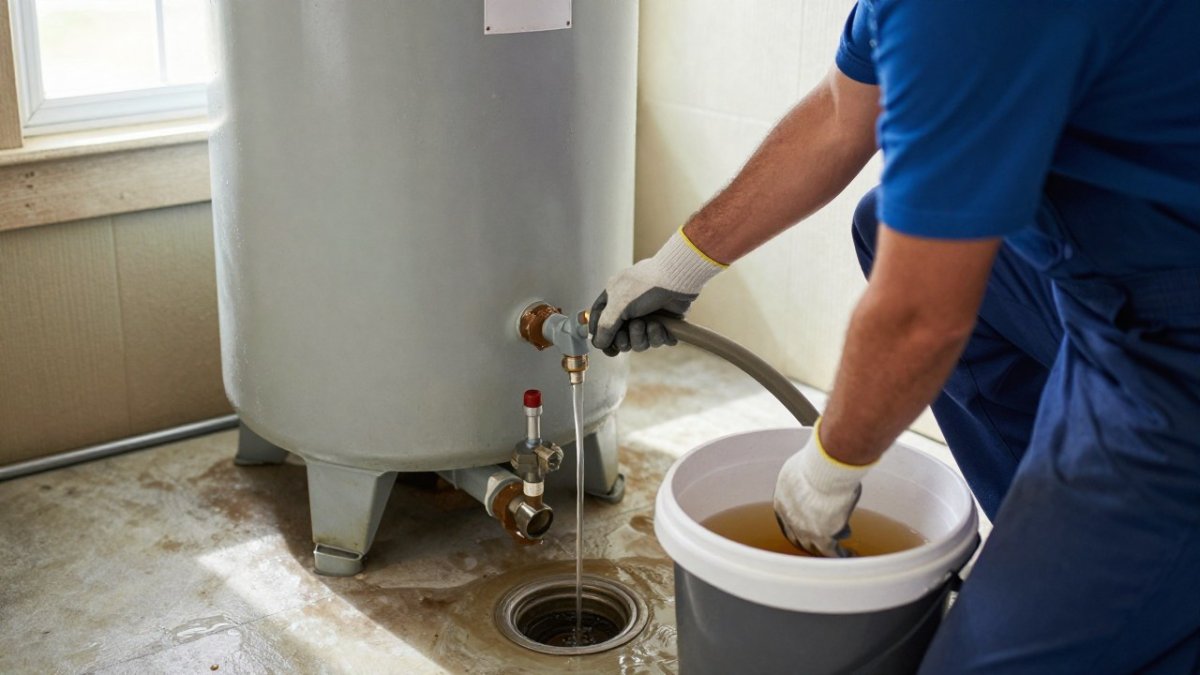
Sediment is the most common cause of low hot water pressure in a storage-tank system, and it is also the most misunderstood.
Hard water accelerates the process. You will often hear popping, rumbling, or crackling from the tank as trapped water boils under the sediment layer. That sound is a diagnostic clue, not just noise.
How sediment actually restricts flow: In a tank system, cold water enters through the dip tube and hot water exits at the top. Sediment rarely blocks the outlet directly; instead it insulates the tank bottom, overheats the steel, and can crack the glass lining or the dip tube.
Tank versus tankless: A tankless unit does not accumulate sediment in a tank, but it does scale on the heat exchanger. Hard water coats the copper or stainless coils, narrows the water passages, and reduces hot flow.
What to check before you flush:
Watch out: never drain or flush a tank while the power or gas is on, and never open the temperature-and-pressure relief valve to speed the process; a stuck relief valve is a scald and pressure hazard.
When flushing will not fix it: If the drain valve clogs with scale, or if you see rust-colored water at the hot taps, the tank may be near the end of its life. A corroded tank can also weep from the base, which is a stop-and-call-a-professional signal. Water heater replacement is the practical next step at that point.
A clogged fixture is the easiest cause to fix and the easiest to overlook. Mineral deposits build up in showerheads, aerators, and inlet screens, and the flow slowly drops.
Check these first:
If the fixture is cracked or too corroded to clean, replacement is the better call. Our faucet installation team handles that swap quickly.
When hot water pressure is low but cold runs fine, the problem lives on the hot side of your plumbing. That narrows the search to the water heater, the hot supply line, or a valve feeding the heater.
Hot water pressure low but cold fine is a useful clue, not a dead end. Cold water bypasses the heater entirely, so a strong cold flow means your main supply and whole-house pressure are healthy.
Common hot-side culprits include sediment in the tank, a failing dip tube, or a partially closed valve on the heater inlet. For a deeper walkthrough, see our hot water guide.
A sudden drop points to a trigger, not slow wear. Think back to what changed in the last day or two.
Sudden drops after a repair are often caused by a valve left partly closed. Check the shut-off valves first.
Low hot water pressure upstairs only usually comes down to gravity and pipe size. Upper floors sit farther from the heater, so they feel pressure loss first.
A failing pressure regulator makes this worse. So do narrow or corroded pipes feeding the second floor. If the upstairs shower trickles while downstairs is strong, measure pressure at both points to confirm.
When hot water pressure low but cold fine in shower is your exact symptom, the cartridge or mixing valve is the prime suspect. These parts blend hot and cold, and a worn cartridge can choke the hot side.
Test the shower by running hot only. If flow stays weak, the cartridge is likely clogged or failing. A tempering valve set too low can also limit hot flow.
Watch out: shut off the water supply before pulling a cartridge. Skipping that step floods the wall.
The least obvious cause is often the real one. A partially closed valve, a failing pressure regulator, or a corroded pipe can quietly throttle your hot water, and the symptom looks identical to sediment or a clogged fixture. The difference is where the restriction sits and how it behaves.
Valves first, because they are free to check. Every hot-water system has at least one shut-off valve: at the heater inlet, on the cold supply feeding the heater, and often on a recirculation loop. A valve that was closed for a repair and only reopened halfway will cut hot flow to every fixture downstream. Turn each valve fully counterclockwise, then back a quarter turn.
Pressure-reducing valves (PRVs): A PRV on the main line protects the house from municipal pressure that can run well above 80 psi. When a PRV fails, it usually fails open, sending high pressure through the pipes, or fails closed, starving the house.
Restricted pipes: Galvanized steel pipes corrode from the inside, and the rust scale narrows the bore until hot flow drops. Copper pipes rarely restrict unless they have heavy scale or a crushed section from a repair. PEX can kink at a tight bend. Look for corrosion at joints, green crust on copper, and any exposed line that has been clamped or bent sharply.
Screw a pressure gauge onto a hose bib and open the valve. Pressure readings well above or below typical residential ranges can point to a supply or regulator problem.
Measure flow separately by timing how long a fixture takes to fill a marked bucket. Low flow with normal pressure points to a restriction, not a supply issue. Low pressure and low flow together point to the main supply or the regulator.
Tank versus tankless: On a tankless system, a restricted inlet filter screen or a scaled heat exchanger mimics a valve problem. Check the inlet screen before you touch any valve. On a tank system, a failing dip tube or a closed recirculation valve is the more common restriction.
When to stop and call: If you find active corrosion, a weeping valve body, or pressure above 80 psi that does not respond to the PRV adjustment, stop. If valves and pipes need real repair, our low water pressure service can take it from there.
Plumbing problems rarely fix themselves, and a trickling hot shower is usually the first sign of a bigger issue. At 308 Solutions Group, we’ve spent more than 45 years helping homeowners and property managers across the metroplex trace these problems to the source.
When cold water flows normally and hot water pressure is weak, the restriction sits on the hot side of the system. Common culprits are sediment buildup at the bottom of the tank, a clogged hot-water inlet screen, a failing mixing or tempering valve, or a partially closed shut-off valve on the hot line. Because the cold line bypasses all of these, it keeps full pressure. Start by checking whether one fixture or every hot tap is affected, then inspect the water heater’s inlet and valves before assuming the heater itself has failed.
A sudden drop points to a change rather than slow wear. Recent plumbing work, a valve that was never fully reopened after a repair, a burst or leaking hot-water line, or a pressure-reducing valve that has failed can all cut hot water pressure quickly. If the drop came with a water bill spike or a damp spot near a line, shut off the supply and call a licensed plumber. A licensed plumber can assess sudden pressure loss promptly.
Upper floors sit farther from the water heater and depend on consistent pressure to push hot water up. A pressure-reducing valve set too low, corroded or undersized pipes in older homes, or a failing pump can leave upstairs fixtures weak while downstairs stays normal. Sediment in the heater compounds the problem because the hot water has less push to travel vertically. A plumber can measure pressure at both levels to confirm whether the cause is the regulator, the piping, or the heater.
Yes. Sediment and mineral scale collect at the bottom of a tank heater and around the outlet, narrowing the path for hot water. In tankless units, scale buildup in the heat exchanger restricts flow and often triggers a low-flow error code. A failing dip tube or a clogged inlet screen has the same effect. Flushing the tank annually and descaling a tankless unit on schedule prevents most of these problems, and a plumber can confirm whether the heater needs service or replacement.
Electrical & Plumbing Licenses:
TECL: 33332 - TSBPE: M-40316
