
Last Updated: November 24, 2026
Quick Summary
Smoke alarm repair means diagnosing why an alarm chirps, false-triggers, or fails to respond, then fixing the battery, sensor, wiring, or mounting issue behind it. Most problems trace back to a battery, dust, or age rather than a failed sensor, so many fixes are DIY. Once a unit passes its service life, replacement takes over.
Smoke alarm repair begins with a simple question: is the unit actually broken, or is it doing exactly what it was designed to do?
A smoke alarm that chirps once every minute is not malfunctioning, it is signaling a low battery, and the fix costs less than a sandwich.
The NFPA guide to smoke alarm safety is clear that working alarms cut the risk of dying in a home fire roughly in half.
Use this table before you touch a screwdriver. It separates the fixes you can handle from the ones that need an electrician.
| Symptom | Likely Cause | Fix or Replace | Who Should Do It |
|---|---|---|---|
| Chirps every 30-60 seconds | Low battery | Replace battery | DIY |
| Chirps, new battery installed | Dust or expired unit | Clean, then check date | DIY, then replace |
| Silent on test button | Dead battery or failed unit | Test battery, then replace | DIY or pro |
| Random false alarms | Dust, steam, insects | Clean sensor | DIY |
| Multiple units alarm together | Interconnected system fault | Diagnose wiring | Electrician |
| Unit older than 10 years | End-of-life sensor | Replace | DIY or pro |
| Alarm sounds with no smoke | Wiring or sensor fault | Inspect circuit | Electrician |
As a general rule, if the fix is a battery or a vacuum, you can do it yourself. If it involves the circuit breaker, the wiring, or a unit that will not reset, call a licensed electrician.
Resetting a hardwired smoke detector takes about two minutes, but the sequence and the reason behind each step matter. Skip a step and the alarm will keep chirping.
Follow this order:
Cycling the breaker is an important step, since pressing reset without cutting power sometimes does nothing. Waiting 30 seconds before reconnecting the harness allows the unit to fully power down so the next start-up runs a clean self-test.
A reset that does not stick is diagnostic, not just annoying. Possible causes include:
Reset behavior is not universal, and the manual for your model beats any generic guide:
If the alarm still chirps after a full reset with a fresh battery, the sensor has likely reached end-of-life and no amount of resetting will fix it. For safe power cycling, see our guide on how to reset a tripped circuit breaker.
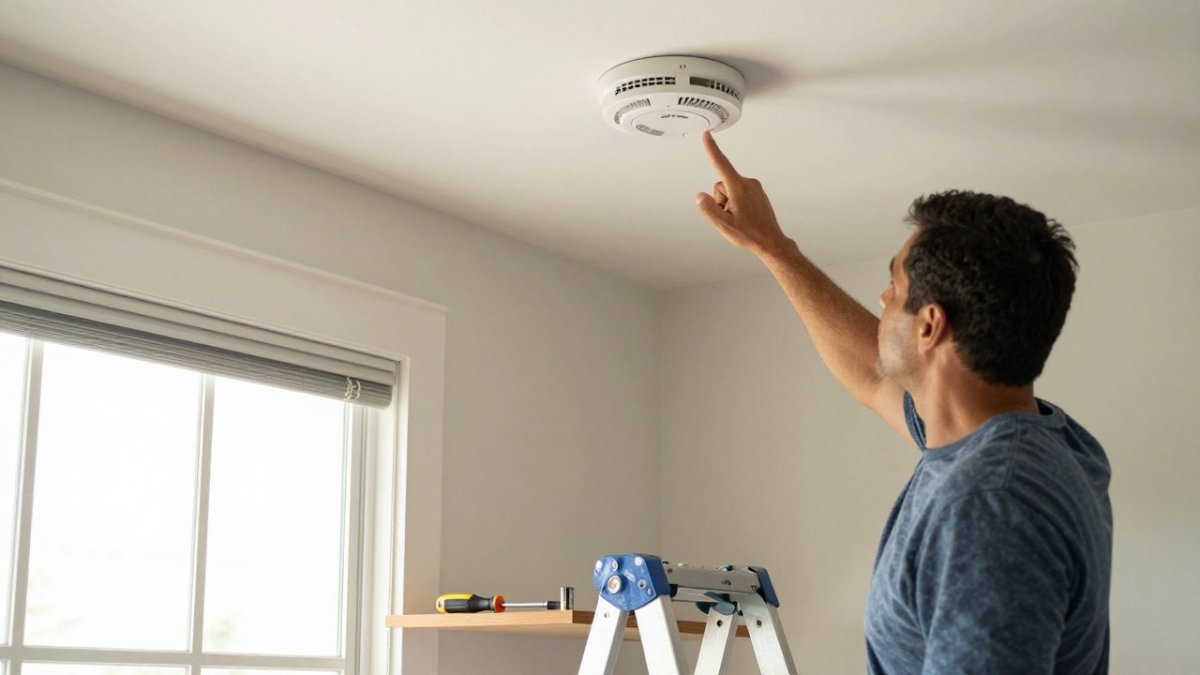
The man is American.
False smoke alarm triggers almost always come down to three culprits: dust in the sensing chamber, steam from a nearby bathroom, or a unit mounted too close to the kitchen. None of these mean the alarm is broken.
Ionization sensors react fastest to flaming fires, while photoelectric sensors are better at smoldering fires and less prone to nuisance alarms from cooking.
Placement matters. An alarm located close to a stove or shower may trigger on steam and grease, so relocating it or changing the sensor type can help.
Dust accumulation is the single most common cause of false alarms, and it is the easiest thing to fix. Once or twice a year, do this:
Never spray cleaning products into the sensor. Moisture and residue can coat the chamber and cause the exact false alarms you are trying to stop. If false triggers continue after cleaning and repositioning, the issue may be wiring-related, and our electrical repair troubleshooting team can trace it.
A smoke alarm needs testing once a month and a new battery once a year. That is the baseline the U.S.
Here is a general maintenance calendar for smoke alarms:
| Task | Frequency | Time Needed |
|---|---|---|
| Press test button on each alarm | Monthly | 2 minutes |
| Vacuum dust from sensor | Every 6 months | 5 minutes |
| Replace battery | Annually | 5 minutes per unit |
| Check manufacture date | Annually | 1 minute |
| Replace entire unit | Every 10 years | Varies |
Time Needed
Battery replacement is straightforward: twist the unit off the bracket, swap the battery, and press test.
A ten-year lifespan applies to the whole unit, not just the battery. The sensor degrades with age, and a smoke detector expiration date is stamped on the back of every modern unit.
Hardwired smoke detector replacement cost depends on three things: how many units, whether the wiring is sound, and whether the existing system is interconnected. A straight swap of a single unit costs far less than replacing a failed interconnect loop across a whole floor.
Because pricing varies by home and scope, a quote is typically provided after an estimate. Factors that can increase the cost include:
If your panel is older, the alarm circuit may be sharing capacity it should not. Our electrical panel upgrades page explains when a panel upgrade makes sense before adding new hardwired units.
Interconnected alarms are a common source of confusing diagnostics. When one unit fails, the whole chain can chirp or stay silent, and the faulty unit is rarely the one making noise. This section covers why every alarm is chirping, whether a smart detector changes the repair math, and what to do with the old unit.
An interconnected system shares power and a signal wire (or a wireless mesh on newer units), so one unit’s problem propagates. Work through this diagnostic sequence:
A common pattern: all units chirp at once with no smoke, and the cause turns out to be one expired unit on the chain. Replacing that unit clears the whole system.
The decision matrix earlier applies unit by unit, but interconnected systems add a system-level question: is the wiring sound? If the interconnect loop is damaged, replacing units one at a time will not fix the chirping. If the wiring is sound and one unit is expired, replace that unit and re-test the chain. If multiple units are past their manufacture date, replace the set rather than chasing faults one at a time.
Smart detectors add app alerts, voice notifications, and remote silencing, but rely on the same sensor and wiring fundamentals. A smart unit with a dirty sensor false-alarms just like a basic one, and a smart unit with a weak backup battery still chirps. The difference is diagnostic: the app often tells you which unit triggered and why, shortening the isolation step above.
Disposal matters more than people think, and it depends on the sensor type:
If you are upgrading alarms in an older home, our electrical safety tips for older homes guide covers the broader wiring questions that come with it.
Most homeowners wait until an alarm fails at 2 a.m. to think about it. A planned inspection removes that scenario entirely.
308 Solutions Group has served residential and commercial properties across the Dallas-Fort Worth area for over 45 years.
If you would rather have a professional confirm your system is sound, book a smoke detector installation and inspection with 308 Solutions Group.
A chirping alarm is a nuisance until the night it matters.
Most smoke alarms are not designed to be repaired. If the unit is chirping after a fresh battery, fails a test, or is past its ten-year lifespan, replacement is the correct call. Smoke alarm repair in the practical sense means resetting, cleaning, or replacing the battery. Anything involving the wiring, the mounting bracket, or a unit that keeps false alarming after cleaning needs an electrician to inspect the circuit and the device.
A chirp after a battery change usually means the battery is not seated correctly, the battery is expired or the wrong type, or the unit is still holding a low-battery signal in memory. Press and hold the reset button for 15 to 20 seconds to clear it. If the chirp continues, check the manufacture date on the back of the alarm. Units older than ten years chirp as an end-of-life warning and need replacement, not another battery.
NFPA standards call for replacing smoke alarms every ten years from the manufacture date, not the install date. The date is printed on the back of the unit. Test every alarm monthly, replace batteries at least once a year or when the low battery signal sounds, and clean the sensor annually. Hardwired units with battery backup still need the same schedule, since the sensor itself degrades over time.
Hardwired smoke detector replacement cost depends on the number of units, whether the existing wiring and mounting brackets can be reused, and whether the home needs interconnected alarms brought up to current code. Pricing information is available on the 308 Solutions Group website, and you can request a quote for your property.
Electrical & Plumbing Licenses:
TECL: 33332 - TSBPE: M-40316
