
Last Updated: November 9, 2026
Quick Summary
To install tankless water heater units safely, first confirm your electrical or gas capacity, then size the unit to your peak household demand at your actual temperature rise. Next, mount the unit, connect the water lines and gas or electrical supply, flush the system, and check every joint for leaks before you power it on.
Before you install a tankless water heater, check whether your home can support one.
Start with the basics. Confirm the unit will fit the wall and that you have clear access for service. Look at your existing water lines, since most units connect to standard half-inch or three-quarter-inch piping.
A quick checklist helps:
The electrical or gas capacity check is often where unexpected issues surface. Learn your current service size before you shop, so you do not buy a unit your home cannot run.
Sizing a tankless heater means matching its flow rate to how much hot water your household uses at the same time, adjusted for how cold the incoming water is. A unit rated in gallons per minute (GPM) must cover your peak simultaneous demand at your actual temperature rise, not at the ideal conditions printed on the box.
The math uses two numbers. First, add up the flow rates of the fixtures you expect to use at once. Second, calculate temperature rise, which is the gap between your incoming water temperature and your target output temperature.
List every fixture likely to run at the same time and use typical flow ratings:
Add the fixtures you realistically run together. A common morning peak is one shower plus one bathroom sink plus the kitchen faucet, or about 4.5 GPM. A household that runs two showers at once plus a dishwasher is closer to 5.5 GPM. Write down your own number rather than guessing.
Temperature rise equals your target hot-water output temperature minus the incoming cold-water temperature. Most households set the heater to about 120 degrees Fahrenheit. Incoming water varies widely by region and season: groundwater in the northern states can run in the 40s in winter, while southern groundwater may sit in the 60s to 70s. A 120-degree target against 50-degree incoming water is a 70-degree rise; against 70-degree incoming water it is only a 50-degree rise.
Manufacturers publish a flow-capacity chart that shows GPM at several temperature rises. Find the row for your calculated rise and confirm the unit delivers at least your peak-demand GPM at that rise. If your peak is 5.5 GPM at a 70-degree rise, a unit rated 7 GPM at a 35-degree rise will not keep up.
Watch out: sizing to the average rather than the peak is the most common cause of a tankless unit that runs cold during morning routines. Size to the busiest 15 minutes of your day, not the daily average.
If your calculated rise is high and your peak demand is large, a condensing gas unit extracts more heat from the same fuel and can deliver more GPM at cold incoming temperatures. If you want hot water at the tap faster, a recirculation pump or a unit with built-in recirculation reduces wait time, though it adds cost and, on some systems, standby energy use. Neither changes the core sizing math: peak GPM at your actual rise still decides whether the unit keeps up.
Typical flow rates per fixture in GPM
Gas and electric tankless heaters both skip the storage tank, but they differ in power source and installation needs. Gas units heat water quickly and suit larger households. Electric units cost less to install in many homes but need a substantial electrical supply.
| Factor | Gas Tankless | Electric Tankless |
|---|---|---|
| Best for | Larger households, high demand | Smaller homes, point-of-use |
| Power need | Gas line, venting | High-amp dedicated circuit |
| Installation | Gas and venting work | Electrical panel work |
| Upfront cost | Usually higher | Usually lower |
A gas unit needs a properly sized gas line and an exhaust vent. An electric unit may need a panel upgrade if your current service cannot carry the added load. Compare what your home already has before choosing.
Installing an electric tankless heater involves three parts: confirming electrical capacity, mounting the unit, and connecting the water lines. Work in that order.
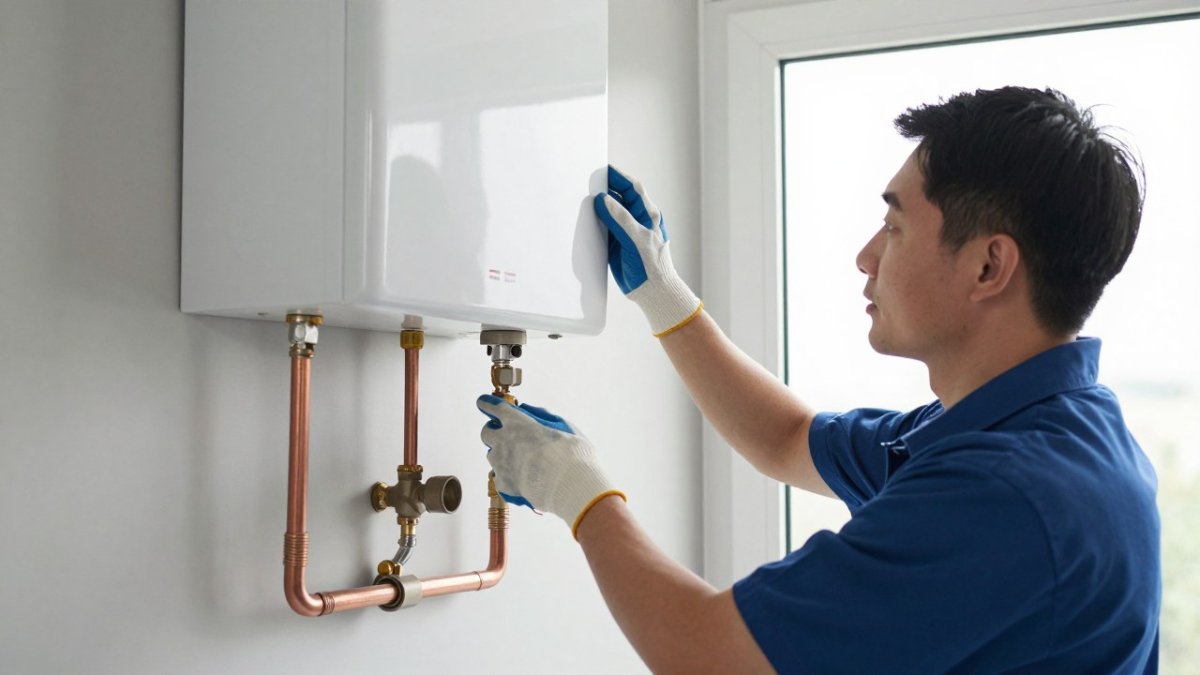
Electric tankless units draw a lot of current, and the required amperage depends on the model. Confirm your panel’s total capacity and whether it has room for a dedicated double-pole breaker. Check the unit’s installation manual for the exact circuit size and wire gauge before you install tankless water heater hardware.
If your panel is near capacity or outdated, plan for a panel upgrade before installing the heater. A licensed electrician can review your service and recommend changes. Many older panels do not have the space or capacity a tankless unit requires.
Mount the unit on a solid wall using the bracket included with the model, following the manufacturer’s clearance requirements. Connect the cold water inlet and hot water outlet, and install isolation valves so you can service the unit later. Use push-to-connect fittings or sweated copper, depending on your piping.
Flush the system before you turn on power. Sediment left from new piping can damage the heating elements. Run water through the unit for several minutes, then check every joint for leaks.
A gas tankless installation follows a diagram: cold water in, gas line connected, exhaust vent routed out, and hot water out. The manufacturer’s diagram shows the exact placement of each connection, and you should follow it closely.
Connect the gas line with a shutoff valve and a sediment trap. Test every gas joint with a leak detection solution. Route the exhaust vent according to the manual, keeping required clearances from windows and doors. Combustion air must reach the unit, so check the vent and air intake requirements before you begin.
The main points to verify:
Installation cost depends on the unit type, the work your home needs, and local labor rates. Pricing varies with quantity, scope and timing, so request an itemized written quote to see where the money goes.
Utility upgrades such as a panel upgrade or gas line resize can add significant cost, which is why the capacity checks earlier in this guide matter before you buy.
Use four tests before deciding who does the work.
A reasonable approach: do the research and capacity checks yourself, then have a licensed professional handle the connections that involve gas, high-voltage electrical, or code-regulated venting. That split captures most of the savings without carrying the safety and warranty risk.
Watch out: skipping the permit to save a fee can surface at resale or insurance review, and an unpermitted gas or electrical connection may need to be redone at your expense.
If you have checked your electrical and gas capacity and want the work done right, 308 Solutions Group handles tankless water heater installation for homes throughout the Dallas-Fort Worth area. With more than 45 years of experience in residential and commercial plumbing and electrical services, we handle panel upgrades and water heater replacements.
Reach out to schedule an assessment and get a written quote. Contact us to book your installation, or see our water heater replacement service if you are comparing unit types. If your panel may need work first, review our electrical panel upgrades and read our guide to warning signs your panel needs replacement. For water line connections, our plumbing repair team can help.
Some homeowners with solid plumbing and electrical skills complete the mounting and water connections themselves, but gas lines and high-amperage electrical work generally require a licensed professional. Many U.S. jurisdictions require a permit and inspection for a new water heater, and an unpermitted installation can complicate home insurance claims and resale. Check your local building department before starting, and follow the manufacturer’s installation manual closely. If any step involves gas, a new 240-volt circuit or a panel upgrade, hire a licensed contractor.
Installation cost depends on the unit type, the capacity needed, whether the gas line or electrical service must be upgraded, and local labor rates. Pricing varies widely, so request an itemized written quote that separates the heater, the labor, any permit fees and any utility upgrades. For current pricing on 308 Solutions Group installations, visit the company website or request a quote directly.
Electric tankless units typically draw a large current and require a dedicated circuit sized to the unit’s rated amperage and a breaker of the correct rating. Gas models do not need a high-amperage circuit but still need a standard power connection for the control electronics. Confirm the required circuit size in the manufacturer’s manual and have an electrician verify that your panel has the capacity before installation.
Most installations require adequate electrical service or gas supply, a water supply that meets the unit’s minimum flow and pressure specifications, a wall or surface that can bear the unit’s weight, proper venting for gas models, a clearance zone around the unit for service, and a permit with inspection under local code. Review the manufacturer’s clearance and venting requirements before you buy the unit.
Electrical & Plumbing Licenses:
TECL: 33332 - TSBPE: M-40316
