
Last Updated: September 11, 2026
A tripped circuit breaker is a safety device doing its job, cutting power when current flow exceeds what a circuit can handle. Most homeowners panic when a breaker trips, but the real question isn’t how to restore power. It’s why the breaker tripped in the first place.
Understanding that distinction separates a quick fix from a recurring problem.
An overload happens when you draw more amperage than the circuit is rated for. Plug a space heater, hair dryer, and microwave into the same circuit and you’ll exceed capacity. The breaker trips to prevent the wiring from overheating.
A short circuit is more serious. It occurs when a hot wire contacts a neutral or ground wire, creating a path of least resistance. The current surge is immediate and dramatic. Short circuits often produce a burning smell or visible scorch marks at the outlet. If you notice either, stop and call a professional electrician. This isn’t a reset-and-hope situation.
Electrical safety isn’t optional. Before you approach your service panel, take these precautions:
Rubber-insulated gloves add protection, though most residential panels don’t require full PPE for a simple reset. The goal is eliminating variables. Water, metal ladders, and jewelry all create unnecessary risk.
Resetting a tripped circuit breaker takes about five minutes when done correctly. The process is straightforward, but sequence matters, and the sequence is not identical for every breaker. Standard, GFCI, and AFCI breakers all trip for different reasons and reset with slightly different motions. Using the wrong motion on the wrong breaker is the most common reason a homeowner thinks a breaker is “broken” when it isn’t.
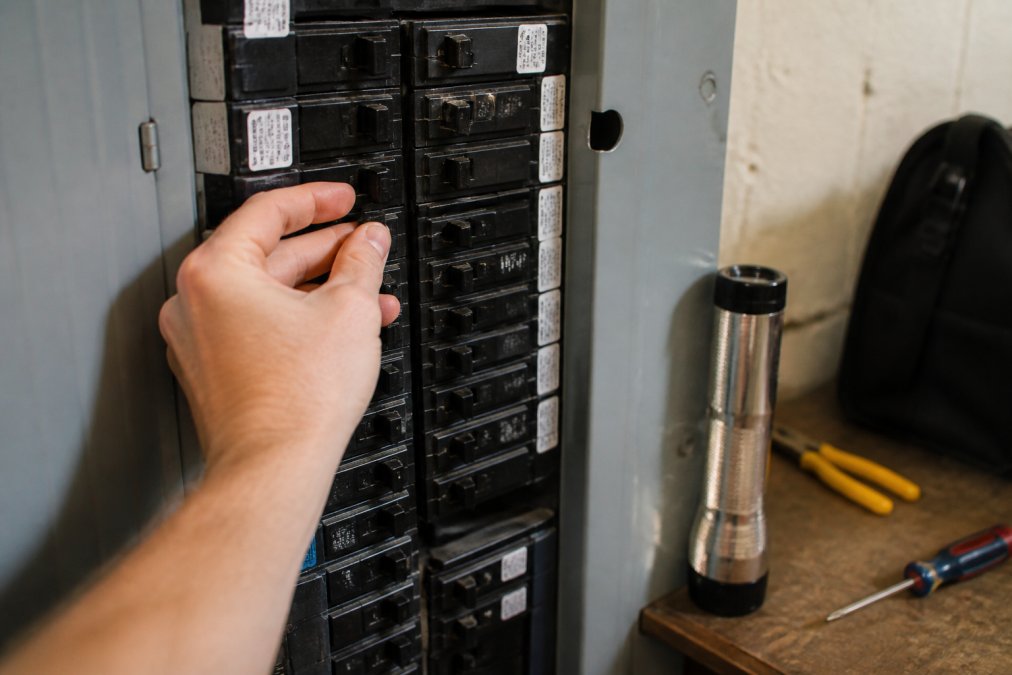
Find your breaker panel, often called a fuse box or service panel. It’s typically in a garage, basement, utility closet, or exterior wall. Open the door to expose the breaker rows.
Look for a breaker that sits in the middle position rather than fully “on” or fully “off.” That middle position is the visual signature of a tripped breaker. Many homeowners miss this because they expect the switch to look clearly off. On most residential panels, the handle sits roughly halfway between the ON and OFF positions, and it may feel slightly loose or springy when you nudge it.
Before you touch anything, look at the breaker itself. The reset motion depends on what you’re dealing with.
If you’re not sure which type you have, the breaker face is labeled. GFCI and AFCI breakers are also wider than standard single-pole breakers and usually have a pigtail wire visible inside the panel.
For a standard breaker: push the toggle firmly to the OFF position first. You’ll feel a distinct click. Then flip it back to ON. This two-step motion resets the internal mechanism. Skipping the OFF step is the single most common mistake, the breaker will not re-engage if you just push it toward ON.
For a GFCI or AFCI breaker whose toggle is already in the ON position but the circuit is dead: press the RESET button firmly until it clicks. If it clicks and holds, power should restore. If it clicks and immediately pops back out, the ground fault or arc fault is still present, do not keep pressing it.
If the breaker holds, power should restore immediately. If it trips again within seconds, stop. Something on that circuit is drawing too much current or there’s a wiring fault.
Once power returns, test the outlets and fixtures on that circuit. If everything works, you’re done. If the breaker trips again, unplug every appliance and device on that circuit and reset once more.
A breaker that holds with nothing plugged in points to an overloaded circuit from too many devices. A breaker that trips with nothing connected points to a wiring problem. That distinction determines your next move.
A circuit breaker that won’t reset after two attempts signals a deeper issue. Don’t keep flipping the switch. Repeated resets on a faulty circuit can damage wiring or start a fire. What most guides skip is the diagnostic sequence, the order in which you rule out causes tells you whether you’re looking at a five-minute fix or an electrician call.
Work through these in order. Stop as soon as one matches your situation.
A standard breaker tripping points to overload or short circuit. A GFCI breaker tripping points to a ground fault, moisture, a damaged cord, or degraded insulation somewhere on the circuit. An AFCI breaker tripping points to an arc fault, a loose connection, a damaged wire, or (in older homes) a shared neutral that the AFCI misreads as an arc.
This distinction matters because the fix is different. A GFCI trip on a bathroom circuit is often a wet outlet or a hair dryer with a frayed cord. An AFCI trip on a bedroom circuit is often a loose backstab connection at an outlet, a real fire hazard.
Unplug everything on the circuit, every lamp, charger, appliance, and power strip. Reset the breaker.
Before you call anyone, look and listen:
If the breaker feels hot to the touch or won’t stay in the “on” position at all, it’s likely failed. Replacement is a job for a licensed electrician.
Not every breaker problem announces itself with a trip. Watch for these warning signs:
Any of these warrant a professional inspection. A failing breaker compromises your home’s entire electrical safety system.
Prevention beats troubleshooting every time. These habits reduce the chance of nuisance trips:
Homes built decades ago often have circuits that can’t support modern electrical loads. If you’re constantly resetting breakers, the panel may be undersized for how you actually live.
Call a licensed electrician when:
Electrical work isn’t a DIY category where mistakes are forgiving. The risks include shock, fire, and code violations that surface during a home inspection.
308 Solutions Group provides expert electrical services for residential and commercial properties throughout the Dallas-Fort Worth area. With over 45 years of experience, our team delivers dependable, high-quality solutions ranging from emergency repairs and panel upgrades to EV charger installations.
A tripped breaker is your home’s way of saying something needs attention. Sometimes it’s as simple as moving a space heater to another outlet. Other times, it’s a warning that your electrical system needs professional evaluation. 308 Solutions Group provides free estimates, competitive pricing, and round-the-clock emergency support for homeowners and property managers throughout the Dallas-Fort Worth metroplex. Whether you need a quick diagnostic or a full electrical build-out, our team delivers dependable solutions backed by decades of experience. Book online today and get your power back safely.
If a tripped circuit breaker won’t reset, turn the switch fully to OFF first, then back to ON. If it trips again immediately, unplug everything on that circuit and try once more. A breaker that still won’t hold has likely failed or there’s a short circuit in the wiring. Stop resetting it and call a licensed electrician to inspect the circuit and panel.
You don’t need to wait. Once you flip the breaker to OFF, give it a few seconds, then flip it back to ON. The brief pause lets the internal mechanism reset. If it trips again right away, don’t keep flipping it. Repeated attempts can damage the breaker and won’t fix the underlying overload or fault.
Resetting a breaker is safe when done correctly. Stand on a dry surface, keep one hand free, and never touch the metal parts inside the panel. The real danger comes from ignoring warning signs like a burning smell, scorch marks, or a breaker that keeps tripping. Those point to a serious electrical hazard, and you should call a professional electrician rather than reset it again.
A breaker that keeps tripping is usually telling you the circuit is overloaded or there’s a fault. Common causes include too many high-wattage appliances on one circuit, a short circuit, a ground fault, or a breaker that’s simply worn out. Preventing circuit overloads means spreading appliances across circuits and upgrading your panel if it’s consistently at capacity.
Electrical & Plumbing Licenses:
TECL: 33332 - TSBPE: M-40316