
Last Updated: November 12, 2026
Quick Summary
Yes, a dedicated circuit for an EV charger is worth it because it is the standard, code-compliant way to power a Level 2 charger and prevents shared circuits from overheating and tripping. EV charging is a continuous load, so code requires the circuit to handle 125% of that load.
A dedicated circuit for an EV charger is a wire run that serves one appliance and nothing else, protected by its own breaker at the panel. No shared outlets, no daisy-chained garage receptacles. The charger gets the full amperage, every time.
A dedicated circuit is the standard, code-compliant way to power a Level 2 charger, and homeowners often ask whether it is worth the cost. The short answer is yes. The longer answer explains why.
Your car pulls power for hours at a time. That kind of draw needs its own path back to the panel.
The National Electrical Code treats EV charging as a continuous load. That means the charger runs at its maximum current for three hours or more.
Code requires the circuit to handle 125% of that continuous load. A 40-amp charger therefore needs a 50-amp circuit.
Compare that to a garage outlet running a shop vac for ten minutes. Big difference in thermal stress.
Plug a Level 2 charger into a circuit that also feeds a garage fridge or workshop lights, and you invite trouble. The breaker trips. Wires heat up. Over time, connections loosen.
A common mistake is assuming a spare 240-volt dryer outlet will do the job. It might, but only if nothing else shares it and the wire gauge matches.
If your breaker does trip, know how to reset a tripped circuit breaker safely before you touch the panel.
Fire hazard tops the list of reasons code exists. EV charging pulls high-amperage current for hours, and undersized wiring gets hot. Hot wiring inside a wall is how house fires start.
The National Electrical Code sets the rules here. Key requirements include:
Voltage drop matters more than people think. A long run from panel to garage can lose voltage, which makes the charger work harder and charge slower.
Watch out: skipping the permit to save time can create problems with your homeowner’s insurance if a fire traces back to the wiring. Check with your insurer and local building authority before work begins.
EV charger installation cost varies widely, and the dedicated circuit work often accounts for a large share of the project. Pricing depends on run length, panel condition, and permit requirements, so request a quote from 308 Solutions Group’s website for current pricing.
Here is what moves the number, and roughly how each driver behaves:
| Cost Driver | Why It Matters | Typical Behavior |
|---|---|---|
| Distance from panel | Longer runs need more wire and conduit | Cost climbs roughly with every additional foot of run; a garage on the opposite side of the house from the panel can double the wire and conduit line |
| Panel capacity | A full panel means an upgrade first | A panel upgrade is its own project and typically the single largest add-on |
| Wire gauge | Higher amperage needs thicker, pricier wire | 6-gauge copper for a 60-amp run costs materially more per foot than the 8-gauge often used on a 40-amp circuit |
| Permit and inspection | Required in most jurisdictions | Permit fees are set locally and usually modest, but the inspection adds a scheduling step |
| Hardwired vs. outlet | Hardwiring skips the outlet but adds labor | A NEMA 14-50 outlet adds a receptacle and box; hardwiring adds labor but removes a failure point |
| Labor access | Finished walls, attics, and crawlspaces slow the run | Fishing wire through finished space is the most common reason two identical homes get different quotes |
Run length and panel condition are the main factors that shape a quote for the same charger. Request a quote for your specific home to see how these factors apply.
Watch out: a quote that omits the load calculation or the permit line is not a cheaper quote, it is an incomplete one, and the missing work tends to surface at inspection.
Request a quote from 308 Solutions Group to get a number that reflects your actual garage rather than a general estimate.
The Level 2 EV charger vs. 240-volt outlet decision comes down to speed and flexibility. A 240-volt outlet lets you plug in a portable charger. A hardwired Level 2 unit stays put and often charges faster.
Most homeowners charging overnight are fine with either. If you drive long distances daily, the hardwired unit earns its keep.
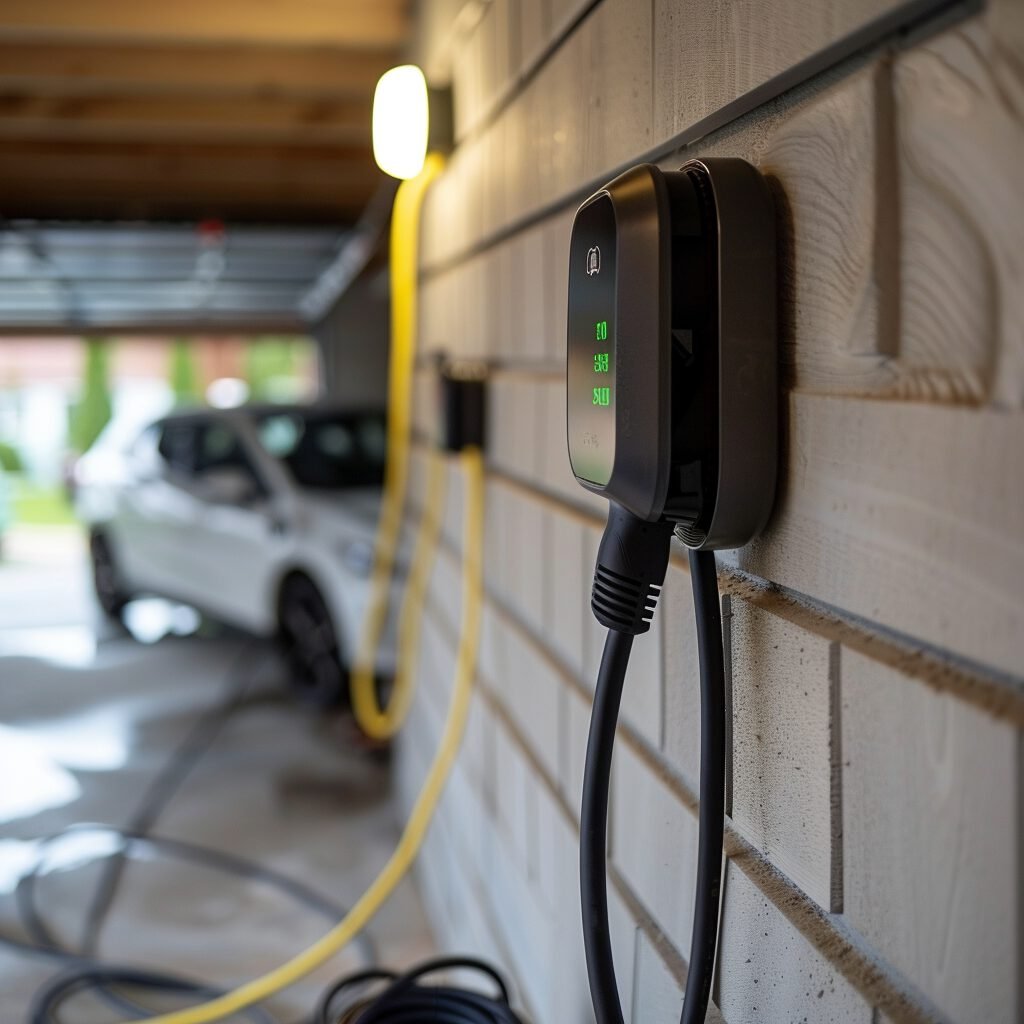
The EV charger 50 amp vs. 60 amp circuit choice depends on your charger and your car. A 50-amp circuit supports a 40-amp charger. A 60-amp circuit supports a 48-amp charger.
Higher amperage means faster charging speed, measured in kilowatt-hours delivered per hour. But your car’s onboard charger has a ceiling too. A 60-amp circuit does nothing extra if the car caps at 48 amps.
Match the circuit to the charger, then confirm the car can use it. Future-ready sizing is smart if you plan to upgrade the vehicle.
A home EV charger panel upgrade becomes necessary when your electrical panel has no room for another breaker, or when the total load exceeds capacity. Older homes with 100-amp service often hit this wall.
A load calculation tells you the truth. It adds up every appliance and checks the total against your panel’s amperage rating.
Signs you may need an upgrade:
If your panel is already suspect, our guide on the warning signs your panel needs replacement helps you judge. When it is time, we handle electrical panel upgrades as part of the charger install.
An energy management device, sometimes called EVEMS (electric vehicle energy management system), can avoid a full panel upgrade. This is the angle most guides miss. You do not always need a bigger panel. Sometimes you need smarter load sharing.
Here is how the mechanism generally works. A load management device monitors total home current and signals the charger to reduce or pause charging when the house approaches its service rating, then resumes charging when demand drops.
Load management devices are one way homeowners with limited panel capacity can charge without a full service upgrade, with the trade-off being charging speed during peak household load.
Potential benefits of load management:
It is not right for every home. A panel with zero spare capacity and an aging service may still need the upgrade, and local requirements for these devices vary, so confirm with your local building authority. A panel that shows rust, heat marks, or a history of tripping is a panel to replace, not to manage around.
Watch out: a load management device is not a substitute for a dedicated circuit. It manages the load on that circuit; it does not let you share an existing garage outlet with the charger.
Before you accept a panel upgrade quote, ask whether a load management device would meet code on your service.
Ready to move forward? The right next step is a load calculation and a clear quote from a licensed electrician.
You can book an EV charger installation with our team, or reach out through our contact page to ask about your garage setup.
Do not leave your charging setup to guesswork. Confirm the circuit sizing with a licensed electrician before installation.
Your car deserves a circuit built for it, not a workaround. 308 Solutions Group brings 45+ years of experience to every install, with free estimates, competitive pricing, and 24/7 emergency service for homes and businesses. Get started with 308 Solutions Group and charge at full speed with a circuit that meets code.
Yes. A Level 2 charger draws a continuous 40 to 48 amps for hours, which is far more than a shared circuit can safely carry alongside other appliances. The National Electrical Code treats EV charging as a continuous load, so the circuit must be sized at 125% of the charger’s rated draw. Sharing a circuit with a dryer or oven invites breaker trips, overheating, and a real fire hazard. A dedicated line is the standard, code-compliant setup for home charging.
It depends on the charger’s rated output and your panel capacity. A 50-amp breaker supports a 40-amp continuous charge. A 60-amp breaker supports a 48-amp charge and suits larger battery packs or households that drive long distances daily. Check the charger’s nameplate amperage first, then confirm your panel has the spare capacity for that breaker size before committing.
Not safely. An EV charger pulls a steady high-amperage load for hours, and any appliance sharing that circuit competes for the same amperage. The result is repeated breaker trips, voltage drop, and thermal stress on the wiring. If a panel upgrade is out of reach, a load management device (EVEMS) is the code-compliant way to share capacity: it pauses or reduces charging when the home’s total draw approaches the panel limit, so the charger never overloads the service.
Only if your panel lacks the spare capacity for the new breaker. A load calculation tells you whether the existing service can handle the added continuous load. Older homes with smaller panels may need an upgrade; newer homes sometimes have room already. A licensed electrician can run the calculation and confirm whether a panel upgrade, a smaller charger, or a load management device is the right fit for your home.
Electrical & Plumbing Licenses:
TECL: 33332 - TSBPE: M-40316
