
Last Updated: September 25, 2026
Failing pipes don’t announce themselves with a warning label. They whisper their distress through small signs that most homeowners miss until the damage becomes expensive. At 308 Solutions Group, we’ve spent over 45 years helping North Texas property owners catch pipe problems early. Knowing how to tell if pipes are failing can save you thousands in water damage repair costs and prevent the kind of emergency that shows up at 2 AM.
Sudden water pressure loss across your entire home indicates a serious problem. When pipes are failing, they develop small leaks that divert water away from fixtures. A pressure drop overnight or over a few days is a red flag.
Check this yourself: turn on multiple fixtures at once (shower, kitchen sink, outdoor hose). If pressure drops noticeably when you demand more water, your main water line or a major branch line likely has a problem. This symptom demands immediate attention because water is escaping into your walls, crawlspace, or yard.
Any sound from inside your walls, dripping, rushing, hissing, or gurgling, means water is moving where it shouldn’t be.
Dripping sounds indicate a slow leak from a pinhole or small crack. Rushing or whooshing sounds mean a pipe has burst and water is spraying into your wall cavity. Hissing sounds point to high-pressure water escaping through a hairline fracture. Gurgling sounds suggest air trapped in lines from a leak disrupting normal flow.
Turn off all water-using appliances and listen in different rooms. If you hear persistent sounds from walls, crawlspaces, or under floors, document when they occur and call a professional immediately. These sounds mean your pipes are failing in real time.
Water stains on ceilings, walls, or floors prove your plumbing system is failing. Look for brown or yellowish stains that spread, soft spongy drywall, peeling paint, visible mold, or sagging ceilings. Stains that grow week to week indicate active leaks; the bigger the stain, the longer the leak has run.
A sudden jump in water usage signals a hidden leak. Compare your current bill to the same month last year; a 10-20% increase warrants investigation, and a 50%+ spike almost certainly indicates an active leak.
Check your meter reading before bed and again in the morning without using water. If the meter has changed, you have an active leak.
Pipe material determines how it fails and what warning signs appear. Understanding your pipe type helps distinguish cosmetic aging from structural failure.
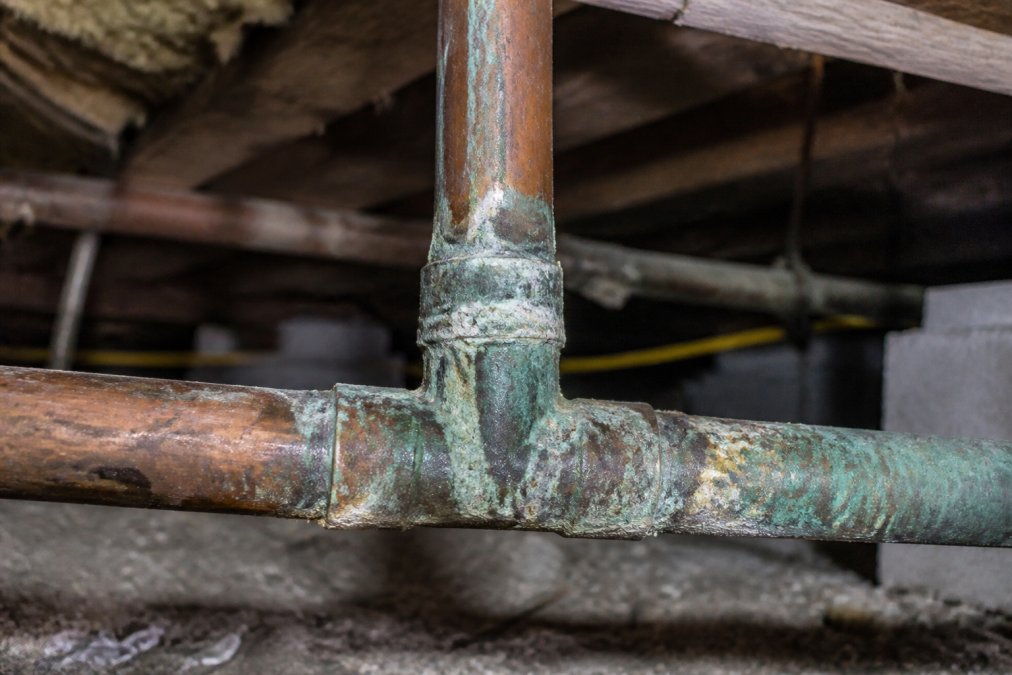
Copper pipes develop a protective greenish patina as they oxidize. However, bright green stains, flaking patina, or indentations mean the protective layer is breaking down. Pinhole leaks appear as small green stains with white mineral deposits. Copper pipes typically last 50-70 years, but aggressive water chemistry can cause pinhole leaks as early as 15-20 years. If your copper pipes are over 30 years old with green staining, professional video inspection is warranted.
Galvanized steel pipes rust from the inside out; the exterior may look intact while interior corrosion is advanced. Discolored or rusty water, brown, orange, or cloudy, is a critical warning sign of structural failure. Rust buildup also reduces water pressure. Galvanized pipes typically last 40-50 years. If your home was built before 1980 with original galvanized pipes, interior corrosion is almost certainly advanced. Rust-colored water is your final warning before major leaks develop.
PEX plastic pipes don’t corrode, but they fail through different mechanisms. Look for visible cracks, splits, or areas where the plastic appears brittle, discolored, or chalky. PEX exposed to direct UV sunlight (in crawlspaces with skylights or outdoor runs) degrades faster and becomes prone to cracking. Freezing temperatures can also cause PEX to split if water inside freezes and expands. PEX has been in common use since the 1980s, and early installations are now reaching 40+ years old. While long-term durability data is still being collected, PEX failures typically manifest as visible splits rather than pinhole leaks. If you see any cracking in PEX pipes, that section should be replaced promptly.
Cast iron drain and sewer pipes (used for waste lines, not supply lines) corrode from the inside and outside simultaneously. Cast iron typically lasts 75-100 years, but homes over 60 years old with original cast iron drains often show signs of failure. Look for slow drains, recurring backups, or sewage odors in your yard or basement, these suggest the pipe interior has corroded enough to trap debris or the exterior has cracked. Cast iron failure is harder to spot visually because the pipes are usually buried or hidden in walls, but persistent drainage problems are the primary warning sign.
Corrosion visible on the outside of pipes means the interior has already suffered damage. Interior corrosion is always more advanced than what you see on the surface. If you can see it, the pipe is likely in its final years of service.
Wet spots on your lawn, basement floor, or crawlspace that appear without rain are leaks escaping from underground or behind walls. These puddles are water that has already escaped your plumbing system.
Watch for:
Different pipe materials have different lifespans. Knowing what you have helps you predict when failure is likely.
Low water pressure from failing pipes requires immediate action to prevent water damage from escalating. Your response in the first hours after you notice the problem can mean the difference between a localized repair and structural damage to your home.
Locate and shut off your main water valve. This is the single most important action. Your main shut-off is typically located where the water line enters your home, in the basement, crawlspace, or near the foundation. It may be a gate valve (turn the handle clockwise) or a ball valve (turn the lever 90 degrees). Shutting off water stops the leak immediately and prevents water from spreading into walls, crawlspaces, and foundations. If you cannot locate your main shut-off, call your water utility, they can show you where it is before an emergency happens.
Document everything with photos and video. Take pictures of water stains, wet spots, puddles, and any visible damage. Record the date and time. This documentation is essential for insurance claims. Photograph the meter reading and any visible corrosion or damage to exposed pipes. Your insurance company will need this evidence to process a claim.
Call a licensed plumber immediately. Even if the leak appears small, professional diagnosis is critical. A plumber can determine whether you have a single failing section or a system-wide problem and recommend the most cost-effective solution.
Professional diagnosis and repair options:
A licensed plumber will:
Modern leak detection technology:
Why timing matters:
The most reliable indicators include sudden drops in water pressure, unusual sounds like hissing or gurgling in your walls, visible water stains on ceilings or walls, unexplained increases in your water bill, and visible corrosion or rust on exposed pipes. Discolored or rusty water from your taps and puddles on floors or lawns are also red flags. If you notice any combination of these signs, your pipes may be experiencing significant deterioration and require professional inspection.
The average life expectancy of plumbing pipes depends on material. Copper pipes generally last 50-70 years, PEX pipes 40-50 years, and galvanized steel pipes 40-50 years. Older homes with original galvanized pipes installed in the 1970s or earlier are at higher risk of failure. If your home is nearing these age thresholds and you’re seeing corrosion or pressure issues, professional evaluation is recommended to assess pipe integrity and plan replacements.
A pinhole leak is a small puncture in the pipe, typically caused by corrosion or oxidation, that produces minimal water damage initially but can escalate over time. A burst pipe is a complete rupture that releases large volumes of water immediately, causing severe structural damage and mold growth. Pinhole leaks may go unnoticed until water stains appear; burst pipes demand emergency response. Both require professional leak detection and repair, but burst pipes are true emergencies requiring immediate water shut-off.
Start by checking your water meter: turn off all water sources, then note the meter reading. If it changes after 30 minutes, you have a leak. Listen for hissing or dripping sounds in walls, especially at night when it’s quiet. Look for water stains, dampness, or soft spots on walls and ceilings. Professional plumbing leak detection methods include acoustic leak detection (sound-based technology), thermal imaging to spot temperature changes from flowing water, and dye testing. If you suspect a leak but can’t locate it, contact a professional, early detection prevents costly water damage and mold.
Electrical & Plumbing Licenses:
TECL: 33332 - TSBPE: M-40316