
Last Updated: November 15, 2026
Quick Summary
Dynamic load balancing is important for EV chargers because it continuously measures total site power at the service entrance and adjusts the charger’s output in real time, keeping draw below the main breaker threshold. This lets you add a Level 2 charger without a service upgrade, throttling charging during peak household demand and ramping back up when the house is quiet.
Dynamic load balancing is important for EV chargers because it lets the charger adjust its draw in real time to whatever capacity your electrical service has free, instead of running at full power and tripping a breaker. For most homes, adding a Level 2 charger is a significant new electrical load. The question most homeowners ask is whether the existing panel can handle it.
Sometimes it can. Often it can’t without help.
That’s the gap dynamic load balancing fills. Instead of forcing a service upgrade, a load management device watches household usage and throttles the charger when the house needs power elsewhere. Below, we walk through the mechanics, where the technology stops working, and when an upgrade is the right call.
A dynamic load balancing device measures total electricity consumption at the service entrance, compares it to a configured limit, and tells the charger how much power is available right now. The charger then adjusts its charging rate to match.
The logic runs in a loop, measured in seconds:
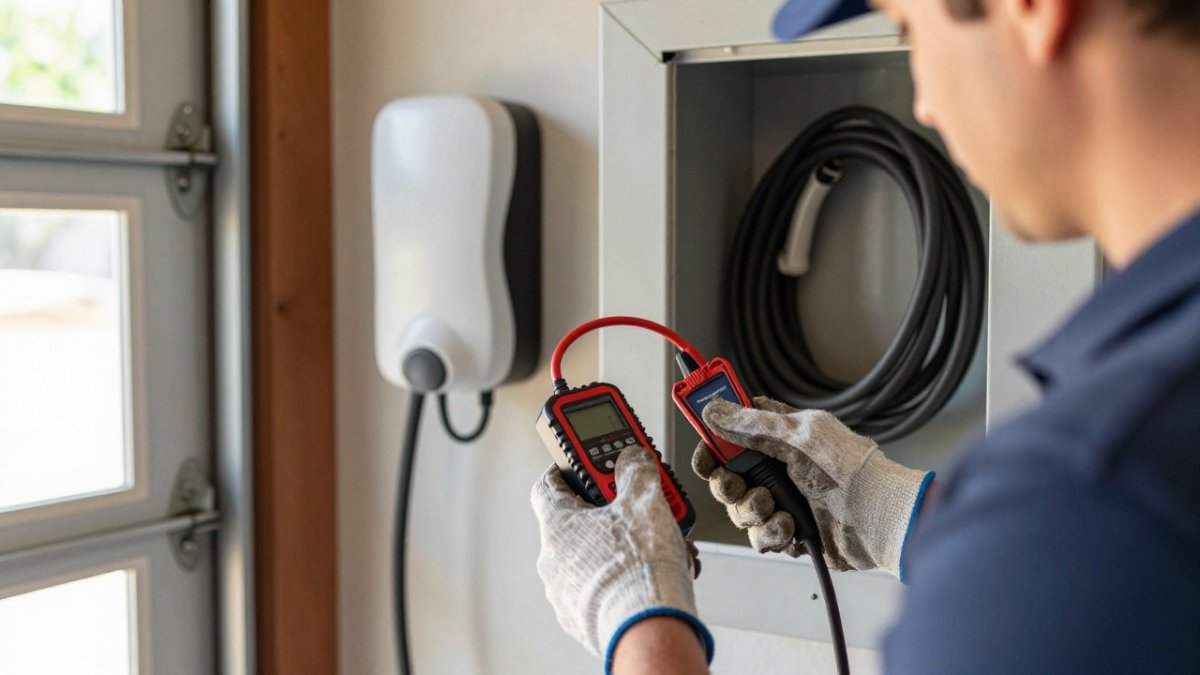
Real-time monitoring separates dynamic load balancing from a fixed power setting. A static approach assumes the worst case and caps the charger permanently; a dynamic system reads actual consumption and gives the charger whatever headroom exists at that moment.
Charging speed varies through the day: when the oven, dryer, and air conditioning run, the charger backs off; when the house is quiet overnight, it ramps back up. If a breaker trips while you’re diagnosing the cause, our guide on how to reset a tripped circuit breaker safely covers the correct sequence.
This is the part most guides skip. If the controller loses contact with the charger, the system must fail safe, not fail open, reverting to a conservative default current or stopping charging until communication returns.
These three terms get used interchangeably in charger marketing, but they describe different control methods with different hardware, failure modes, and costs. Treating them as synonyms is how buyers end up with a system that does not protect their service capacity.
Dynamic load balancing measures total site consumption continuously, typically every few seconds, and adjusts the charger’s power setpoint in real time against a configured service limit.
Static load management sets a fixed maximum current at commissioning and never changes it, for example, capping a 48-amp charger at 24 amps because the panel cannot support more.
Smart charging is schedule- or signal-based. It shifts charging to off-peak windows, follows time-of-use rates, or responds to utility demand-response events.
| Approach | What it reads | Adjusts to live load | Protects service capacity | Hardware required | Typical use |
|---|---|---|---|---|---|
| Dynamic load balancing | Real-time site power at the service entrance | Yes, continuously | Yes | Controller, current sensors or meter, comms link, compatible charger | Tight service capacity, multi-load homes |
| Static load management | Nothing after commissioning | No, fixed cap | Yes, conservatively | Configuration only | Simple, predictable setups with known headroom |
| Smart charging | Clock, utility signal, or tariff schedule | No, schedule-based | Not by itself | Networked charger or app | Lower energy costs, off-peak charging |
The methods are not mutually exclusive. A dynamic controller with a time-of-use schedule gives you capacity protection during the evening peak and cheaper charging overnight.
How to choose. Start with the electrical facts. If the service has enough headroom for the charger at full output plus normal coincident household load, static management or none may be fine.
Limitations to weigh. Dynamic systems depend on sensors, communication, and a controller, adding failure points static setups lack. Static systems cannot reclaim headroom, so they may leave charging speed on the table.
Watch out: a charger marketed as “smart” may only support scheduling and have no input for an external power limit.
Start with the electrical facts, not the charger brochure: your service amperage, panel rating, the capacity of the circuit you plan to use, and the charger’s maximum output. Everything else follows.
A short checklist to use before choosing a unit:
Confirm service capacity and main breaker rating
Identify spare breaker space and circuit capacity
Verify the charger supports an external load management controller
[ ]
Check fallback behavior on communication loss
Review the EV charger installation scope before purchase
Charger compatibility matters more than most buyers expect. Not every wall unit accepts an external power limit signal, and some only support their own manufacturer’s controller. If you want a single company managing the whole electrical side, you can contact us to scope the job.
A dynamic load balancing kit typically bundles the controller, current sensors or a power meter, the communication wiring, and mounting hardware. The charger is usually sold separately unless you buy a matched bundle.
What most buyers miss is that the kit’s usefulness depends on the charger. A controller that speaks only one protocol is a dead end if you change vehicles or swap chargers later. Ask whether the kit supports an open standard or is locked to a single brand.
Installation requirements vary by kit: some need a dedicated breaker for the controller, some mount inside the panel enclosure, and some require network access for firmware updates. Confirm the kit is listed for use with your specific charger model before ordering.
A dynamic load balancing device prevents breaker trips by keeping total service draw below the main breaker threshold at all times. It does this by treating the charger as a flexible load, the first thing to reduce when the house needs power.
Breaker trips happen when simultaneous demand exceeds capacity. Add a dryer, an electric range, and a Level 2 charger on a service with limited headroom, and the main breaker does its job. The device’s job is to make sure that combination never occurs at full charger output.
Overload prevention is not the same as circuit protection. The breaker still protects the wiring. The load management device protects the service capacity. Both need to be correct.
A dynamic load balancing Wallbox setup pairs the wall unit with a compatible energy management controller that reads site power and issues power limits. Setup requires configuring the service limit, sensor placement, and the charger’s response curve.
Compatibility is the sticking point. Confirm three things before buying: the charger firmware supports external power control, the controller is on the charger’s approved list, and the installer has configured fallback behavior. Wired communication is more reliable than Wi-Fi in a garage with a metal door.
Abstract benefits are easy to nod along to. The decision gets clearer when you watch available capacity move as appliances cycle on and off.
The setup. A 100-amp service provides roughly 24,000 watts at 240 volts, but the main breaker is a limit, not a target.
Scenario 1: Quiet house, overnight. Baseline household load is a refrigerator, standby electronics, and a few lights, call it 500 to 800 watts.
Scenario 2: Evening peak. The range is on for dinner, the dryer is running, and the air conditioner cycles on.
Scenario 3: Everything at once. Range, dryer, air conditioner, water heater, and microwave converge. Household load approaches the service limit.
When load balancing is not enough. If the service is already near capacity at baseline, electric resistance heat, an electric water heater, and a range all running through the evening, the controller may have little headroom to give the charger, and charging could be slow or intermittent. If the panel is failing, undersized, or has no spare breaker space, load balancing does not fix that. Signs my electrical panel needs replacement can help you check whether that is the case. Electrical panel upgrades address capacity permanently.
The economics. The cost of a dynamic load balancing kit and its installation depends on the equipment, the panel, and the job.
Multi-vehicle and priority settings. In households with two EVs, dynamic controllers can allocate available capacity across chargers rather than splitting it evenly. Many systems support priority settings, a primary vehicle charges first, or the one with an earlier departure time gets precedence, and minimum-charge guarantees so neither car is stranded. Confirm these controls exist in the controller you choose, because they are configured at installation, not added later.
A controller configured with an incorrect service limit or misplaced sensors will manage to the wrong number, so commissioning matters as much as the hardware.
Adding an EV charger shouldn’t mean gambling on whether your panel can take it.
In most homes, yes. A Level 2 charger draws 32 to 48 amps continuously, which can push a 100- or 150-amp service close to its limit when the AC, oven, and dryer run at the same time. Dynamic load balancing monitors total household electricity usage and adjusts charging power so the panel stays within its service capacity. It is especially important in older homes or where the electrical panel has little spare room for a new dedicated circuit.
It is designed to. A dynamic load balancing device reads real-time current from a sensor at the main service or the charger circuit and lowers charging power before the total load exceeds the breaker’s rating. That prevents the overload prevention problem that causes breaker trips when a charger runs alongside other high-draw appliances. No system is a substitute for a panel that is already undersized or faulty, so an electrician should confirm your service capacity first.
It can reduce charging speed during peak household demand, but only when needed. When the house is drawing little power, the charger runs at full rate. When the AC, range, or dryer kick on, the control system reduces charging power to share capacity. In practice, most home charging happens overnight when household electricity usage is low, so the charging rate stays near maximum and charging availability is rarely affected.
Often it can. A service upgrade to 200 amps requires permits and utility coordination, and its cost depends on the scope of the work. Dynamic load balancing lets an existing panel share its available power between the charger and the rest of the home, which can avoid electrical upgrades in many cases. An electrician still needs to verify circuit capacity, wire sizing, and local code requirements before relying on it instead of a panel upgrade.
Many home charger models offer dynamic load balancing as an add-on accessory or built-in feature. The feature usually requires a power meter or current sensor installed at the panel plus configuration in the charger’s app. Compatibility varies by model and firmware, so confirm the specific charger supports dynamic load management before purchase, and have a licensed electrician handle the sensor installation.
Electrical & Plumbing Licenses:
TECL: 33332 - TSBPE: M-40316
