
Quick Summary
Affordable plumbing services in Justin, TX come down to knowing how plumbers bill and comparing written, itemized estimates. Verify a plumber’s Texas license, insurance and bond first, then compare total costs, not just the hourly rate. Get labor, parts, service fees and permits as separate lines before work starts.
Affordable plumbing services near me in Justin, TX start with understanding how plumbers charge. Homeowners who know the billing structure can compare quotes fairly and avoid surprises. Most residential plumbing work is billed by the hour, by a flat rate for a specific job, or through a combination of both with a service fee added on top.
We recommend asking every plumber to state their billing method before any work begins. A written answer protects you if the final invoice looks different from the first conversation.
Hourly billing charges for the time a technician spends on your job, usually including travel and setup. It suits diagnostic visits and open-ended problems where the scope is unclear.
Service fees are separate charges, often a trip or dispatch fee, that cover the cost of sending a technician to your home. Some companies roll this into the labor price. Others list it as its own line item.
A low hourly rate can cost more in practice. A plumber with a lower hourly rate may still cost more if the job takes considerably longer than another company’s estimate for the same work.
Parts and materials also change the picture. A low quote that excludes fittings, valves, or permits often grows once the work starts. Request a total that shows labor, parts, fees, and any permit costs as separate lines.
Choosing a plumber during an emergency leads to rushed decisions. Homeowners who research providers ahead of time can call with confidence when a pipe fails. Start by building a short list of two or three licensed local companies, then run each one through the same verification steps below. This turns a vague “check their credentials” instruction into a repeatable process you can finish in about 15 minutes per company.
Plumbing in Texas is regulated by the Texas State Board of Plumbing Examiners (TSBPE) (License Types). Every licensed plumber and plumbing company should be able to give you a license number. Ask for it, then confirm it yourself using the TSBPE’s online license search. When you look up the record, check that the license status is active, that the license type matches the work, and that the business name on the license matches the company you are hiring.
Texas State Board of Plumbing Examiners license search
Ask the company to email you a certificate of insurance (COI) showing general liability coverage and workers’ compensation. Do not accept a verbal “we’re insured.” The COI should list the policyholder name that matches the company and show current effective dates. Ask how the company handles injuries on your property and get the answer in writing. Without workers’ comp, an injury on your property could become your responsibility.
Ask whether the company is bonded and request the bond number and surety name. A bond gives you a financial remedy if the contractor fails to complete work or violates licensing rules. Then check complaint history: the TSBPE publishes disciplinary actions, and your local Better Business Bureau profile shows complaint patterns and how the company responded. Look for a pattern of unresolved complaints about pricing or workmanship, not a single outlier.
Online reviews show patterns over time. Look for consistent comments about punctuality, honest pricing, and cleanup, rather than focusing on a single extreme review. Cross-check the company’s own website testimonials against independent review sites, glowing quotes that appear only on the company site are weaker evidence. Ask neighbors, friends, and family which local plumbers they have used and whether the work held up.
Check each company’s listing and website for a clear service area, a local phone number, and a physical address. Confirm that the business serves your area and ask for a realistic arrival window, not just “we’ll be there soon.” Companies that dispatch from far outside the area may charge higher trip fees or arrive late. Keep your short list to companies that can state a response time in writing.
A written, itemized estimate is the most useful document you can request before work begins. Verbal quotes make it hard to hold anyone accountable later. A proper estimate lists labor hours, parts, materials, service fees, permit costs, and the expected completion date. But the estimate is only half the protection, the contract and payment terms around it are where most surprise costs hide.
Ask for each of these as a separate line, not bundled into one lump sum:
Watch out: an estimate that reads “plumbing repair, $400” with no detail gives you no way to check the work. Ask for line items before you sign anything.
The estimate should state the scope in plain language: what will be repaired or replaced, and what is explicitly excluded. The most important sentence to get in writing is that the estimate is the maximum price unless you approve a change in writing. When a plumber discovers a hidden problem, a corroded fitting behind a wall, a cracked flange, the fix should come to you as a change order: a short written description of the additional work and its price, which you approve before it proceeds.
Ask what deposit, if any, is required and what it covers. A common pattern is a deposit for special-order materials (a particular water heater, for example) with the balance due on completion. Be cautious of large upfront payments before any work begins. For permitted work, confirm in writing that the company will pull the permit, not ask you to pull it as the homeowner, and that the price includes the inspection.
Many homeowners find that a free estimate only becomes useful when it is put in writing with these terms attached. Ask the plumber to confirm in writing that the estimate is the maximum price unless you approve a change, this single sentence prevents a surprise invoice.
Place two or three written estimates next to each other. Compare them line by line, not just by the final total. Look at what each one includes, what each excludes, and how each handles unexpected problems.
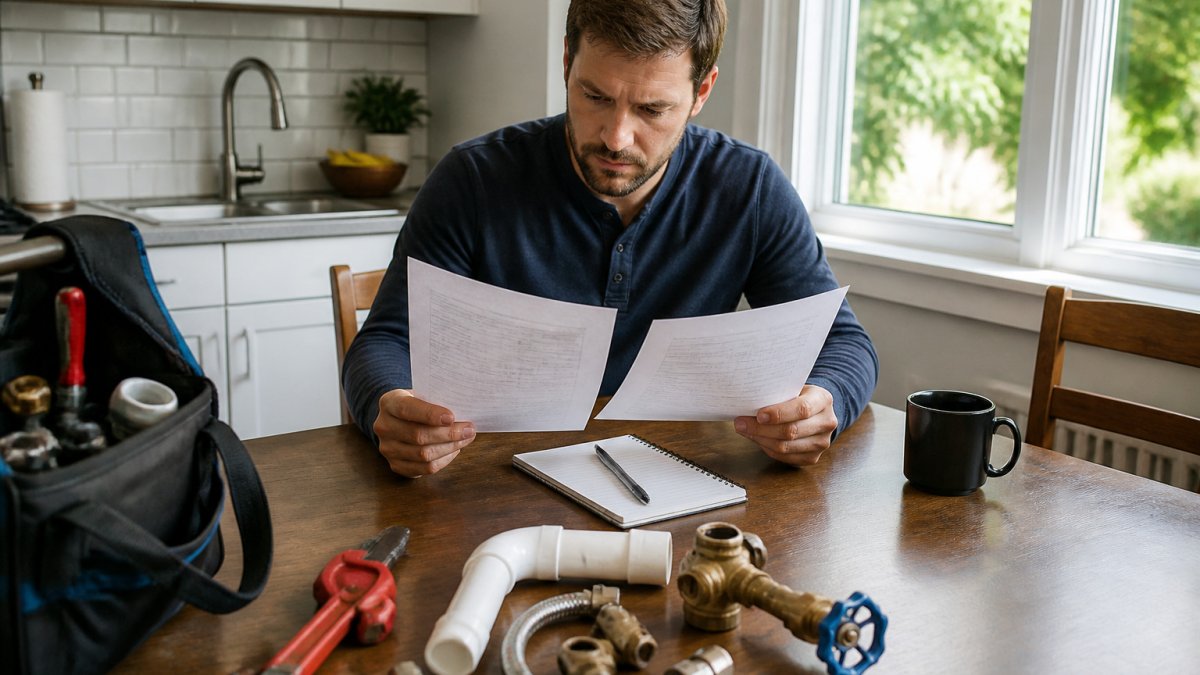
Create a simple table with the same categories for every quote: labor hours, labor rate, parts, service fee, permit fee, warranty length, and estimated completion time.
| Quote item | Company A | Company B | Company C |
|---|---|---|---|
| Labor rate | Hourly | Flat rate | Hourly |
| Service fee | Included | Separate | Included |
| Parts | Listed | Not listed | Listed |
| Warranty | 1 year | 90 days | Not stated |
Ask each company to explain any difference you find. A reasonable answer reveals real differences in scope or materials. A vague answer is a warning sign.
Asking the right questions before work begins reduces disputes later. Use this list when you call or meet with a plumber:
A plumber who answers these questions clearly and in writing is usually a safer choice.
Emergencies create pressure to hire the first company that answers. Even so, you can move quickly without skipping the basic checks.
If the situation is urgent, shut off the water at the main valve to limit damage while you call. Then use the questions above to screen the first two or three companies that can arrive within a reasonable time.
308 Solutions Group provides plumbing repair services for homes and businesses, backed by more than 45 years of experience. The company also offers free estimates and 24/7 emergency support, so you can get an itemized quote before work starts. Visit the plumbing repair service page to review the services offered and how a visit is arranged.
If you live in Justin, see the local plumbing service page to confirm coverage for your area before you book. For a quick check on whether a problem needs urgent attention, review how to tell if pipes are failing: warning signs of failing pipes. Homeowners who want to understand what a fair estimate should include can read our guide on avoiding surprise plumbing charges. Before hiring any contractor, check whether the work needs a permit by reading whether you need a permit for plumbing work.
A written plumbing estimate should list each labor task, the hourly rate or flat fee, parts and materials with individual prices, any service call or trip fee, and the total. It should also state whether the price is fixed or an estimate that may change once the work starts. Ask the plumber to explain any line item you do not understand before you approve the job. An itemized document makes it far easier to compare two bids fairly and to spot padded charges.
Many plumbers charge a service call or trip fee to come to your home, and some apply that fee toward the repair if you hire them. Others roll it into a flat-rate price. Ask whether the fee is waived, credited, or added on top of the repair cost before the visit. Get the answer in writing so you are not surprised by an extra charge on the final bill.
Get at least two or three written quotes for the same job, with the same scope described to each company. Compare the total price, the labor rate, the materials listed, warranty terms, and the timeline. A much lower quote can signal missing work or cheaper parts, so confirm that each bid covers the same repair. Ask each company to explain any difference between their quote and the others.
Plumber rates vary by company, experience, and the time of day, so there is no single going rate. Expect hourly labor charges plus a service fee, or a flat rate for common repairs, and higher charges for after-hours or emergency calls. The most reliable way to know what you will pay is to request a written quote from several local companies for the same job.
Electrical & Plumbing Licenses:
TECL: 33332 - TSBPE: M-40316
