
Last Updated: November 21, 2026
Quick Summary
Most homes don’t need sewer line cleaning on a fixed schedule; clean it when the pipe shows it needs it, not because a calendar says so. Match frequency to your risk level: newer plastic pipe with no trees may only need inspection every few years, while older clay or cast iron pipe with heavy roots needs annual inspection and cleaning as findings show.
Most homes don’t need their main sewer line cleaned on a fixed schedule. The honest answer to how often should you clean main sewer line piping is simple: clean it when the pipe tells you it needs it, not because a calendar says so.
Here’s the part most guides get wrong. They hand out one number, “every year” or “every two years,” and treat every house the same. Your pipe’s age, material, and the trees above it matter far more than the calendar.
Sewer line cleaning is the process of removing buildup, roots, and debris from the pipe that carries wastewater from your home to the city main. Done at the right time, it prevents backups. Done blindly, it can damage a pipe that was already failing.
Your cleaning frequency should match your risk level, not a one-size-fits-all rule. Use this table to find where your home lands.
| Risk Level | Who This Fits | Suggested Interval | What to Watch |
|---|---|---|---|
| Low | Newer plastic pipe, no trees, no past clogs | Inspect every few years; clean only if needed | Sudden slow drains |
| Moderate | Older pipe, some trees, one past clog | Inspect every 1-2 years | Gurgling, odors |
| High | Clay or cast iron pipe, heavy roots, recurring clogs | Annual inspection, clean as findings show | Repeat backups |
A common approach is to inspect first and clean second. That keeps you from paying for a cleaning your pipe didn’t need. Many homeowners find that a camera check every couple of years is enough to catch trouble early.
Stop waiting for a full backup. Your sewer line gives plenty of warnings first. Slow drains in more than one fixture, gurgling sounds after you flush, and sewer odor in the yard are the classic trio. Any one of them means you should call a licensed plumber.
Watch for these signs that the main sewer line needs attention:
If sewage is backing up into the home, treat it as urgent. Stop using water and call for help right away. You can book a professional plumbing inspection to confirm what’s happening before the problem spreads.
Buildup in a main sewer line comes from three interacting forces: what goes down the drain, the condition of the pipe wall, and what grows or settles into the line from outside. Understanding the mechanism matters because each cause calls for a different fix, a snake clears a soft clog, jetting scours wall buildup, and neither solves a root problem or a broken pipe.
Grease, oils, and fats are the classic culprit. They are liquid when warm and solidify as they cool, coating the pipe wall in a sticky layer that grabs everything passing by. Wipes labeled “flushable” do not break down like toilet paper and snag on that layer. Hair and soap scum bind together and form rope-like masses. Over time these layers narrow the pipe, and the narrowing accelerates as more debris catches on the rough surface.
Older pipes fail in predictable ways, and the failure mode determines what kind of blockage you get.
Tree roots are the quiet culprit. Roots seek moisture and find tiny cracks or loose joints, then grow inside the pipe. Once inside, they form a mat that catches grease, wipes, and paper. Root intrusion is one of the most common causes of a major blockage in older neighborhoods, and it is the cause most likely to return after a cleaning if the root is not cut and the entry point is not addressed. If your home has mature trees near the line, expect to deal with roots eventually. Learning how to tell if pipes are failing helps you catch these problems before a root turns into a full blockage.
A main sewer line runs from the home’s cleanout to the city main, and blockages tend to form at predictable points: at the cleanout itself, at a sagging low spot, at a shifted joint, and at the connection to the city main. A clog that recurs in the same spot is telling you the pipe has a defect there, not that the drain needs more frequent cleaning. That is why a camera inspection before cleaning matters, it shows whether the blockage is soft debris, roots at a joint, or a belly that will keep trapping waste no matter how often you clean.
A camera inspection should come before any cleaning, not after. A sewer camera shows the pipe’s true condition: cracks, roots, bellies, and offsets. Cleaning blind is how homeowners pay for a jetting that makes a cracked pipe worse.
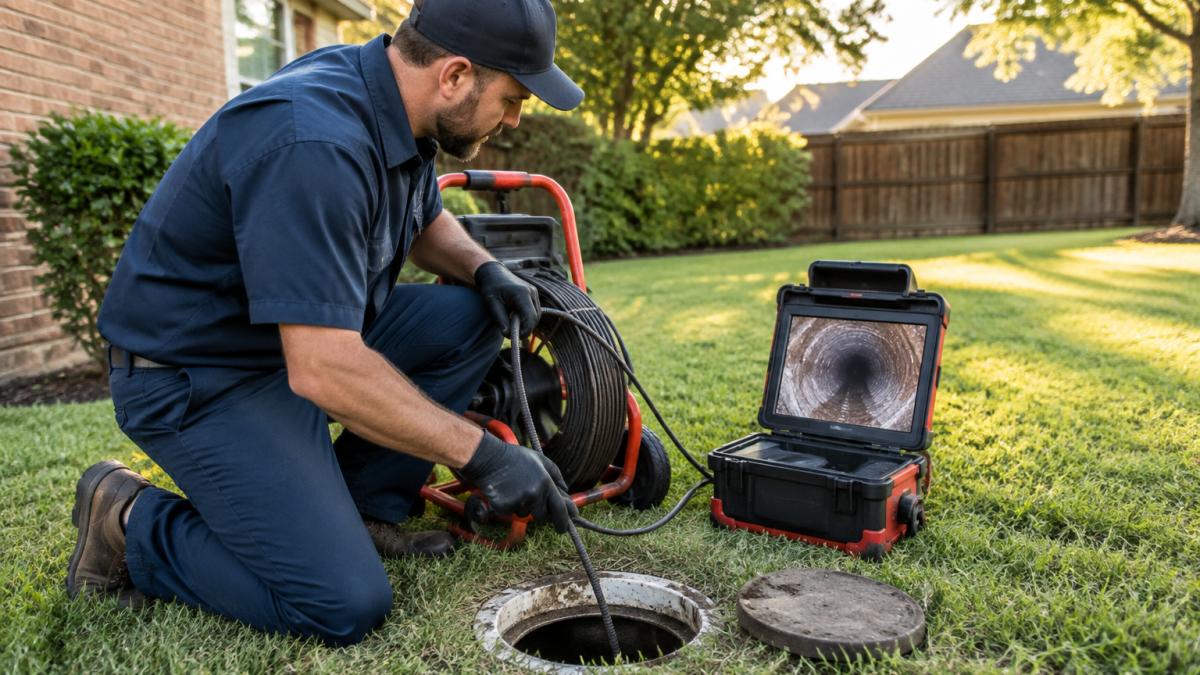
Here’s what most guides miss. The camera tells the plumber which method to use and whether cleaning is even safe. If the pipe is collapsed, cleaning won’t fix it, and repair comes first.
A camera check is quick and gives you a clear picture of what’s underground. It also documents the condition in case you sell the home later.
Snaking and hydro jetting solve different problems. A drain snake, or mechanical cleaning, breaks up a single clog and pulls it out. It’s the right call for a simple blockage or a quick emergency.
Hydro jetting uses high-pressure water to scour the pipe walls clean. It removes grease, scale, and roots that a snake leaves behind. Jetting is better for recurring clogs and heavy buildup, but it must be done carefully on older or fragile pipe.
| Method | Best For | Limitation |
|---|---|---|
| Snaking | Single clog, quick fix | Leaves wall buildup behind |
| Hydro jetting | Grease, roots, recurring clogs | Can damage weak or cracked pipe |
The choice depends on what the camera finds. On a fragile line, jetting at full pressure can cause a break. That’s why inspection comes first. If a line is damaged, sewer repair may be the real answer instead of another cleaning.
You can handle a minor clog yourself, but know when to stop. Start with the cleanout, not the fixtures. A main sewer line cleaner works best when you reach the blockage directly through the outdoor cleanout.
Follow these steps:
Watch out: never pour chemical drain cleaners into a main line. They can damage pipe and don’t clear roots or heavy buildup. If the clog returns or water won’t move, stop and call a pro.
Main sewer line cleaning cost depends on the method, the access, and what the camera finds. Pricing varies by job, so ask for a clear estimate before work starts.
A visit may involve locating the cleanout, running a camera, and clearing the line with the appropriate method. To avoid surprise charges, read our guide on avoiding surprise plumbing charges before you book.
What to ask before the visit:
Several things affect the time:
If the crew finds a collapsed pipe or major root intrusion, the job turns into a repair. That’s a different timeline, and a good plumber will walk you through it before starting.
If you’ve had recurring clogs, roots, or an older pipe, annual inspection pays off. For newer homes with no history, cleaning every few years is plenty.
Many homeowners find that fall and spring are good times to check the line. Fall leaves and winter roots put pressure on the system.
The key is to match the schedule to your pipe. A home with clay pipe and a maple tree overhead needs more attention than a newer build with plastic pipe and open yard.
If you’re ready to set up a schedule or have a slow drain to check, contact us and we’ll help you plan the right interval for your property.
Cleaning a main sewer line on a schedule only helps when the schedule fits your pipe.
Most homes do well with sewer line cleaning every 18 to 24 months, but the right interval depends on your pipes. Older cast iron or clay lines, mature trees near the lateral, and a history of recurring clogs call for annual cleaning. Newer PVC lines with no root intrusion may need it only every few years. A camera inspection tells you what your specific line actually needs instead of guessing.
Watch for multiple slow drains across the house, gurgling sounds from toilets or tubs, sewage odor indoors or in the yard, and water backing up in floor drains or the washing machine standpipe. Repeated clogs in the same fixture are another signal. Any of these means waste is not moving freely through the main line, and it is worth scheduling an inspection before a full backup happens.
You can handle a simple blockage with a drain snake or a manual auger through the cleanout, and a plunger works for a single slow fixture. Skip chemical drain cleaners, which can damage older pipes. If the clog returns within weeks, affects multiple drains, or sits beyond the cleanout, stop and call a licensed plumber. Roots and collapsed pipe need a camera inspection and mechanical cleaning, not a homeowner tool.
Main sewer line cleaning cost varies with line length, access, clog severity, and whether a camera inspection is included. Root intrusion or a heavily scaled line takes more time and equipment than a routine clearing. 308 Solutions Group offers free estimates, so you get a clear number before any work starts.
Electrical & Plumbing Licenses:
TECL: 33332 - TSBPE: M-40316
